How to live from water and sunlight
A guide to photosynthesis in plants and animals.
We all wished at one moment of our life that eating was not such a necessity. So much time and resources saved if we could limit it! Food plays an enormous role in our lives. It is one of the most important bodily needs that we have, and like all living beings, we evolved around the fulfillment of this need.
But why do we need to eat? The answer is a simple yet complex one: like the impossibility of perpetual motion, our body cannot produce more energy than is used to create it. Thus, external energy sources, but also carbon and nutrients are needed, and this is where food comes into play. Some organic compounds needed to maintain optimal body functions, such as vitamins or carbohydrates (i.e saccharides), cannot be produced by our cells and need to be brought in by consuming other living beings capable of their syntheses.
However, there is one kingdom of organisms that do not need to consume others to sustain themselves, and they are, you guessed it, the plants! Needing only sunlight and water to survive, with some earth thrown in the middle, they are the perfect organism to study if we want to see if surviving without consuming our fellow pluricellular beings is possible.
We will therefore have three aims in this article:
- First, define what photosynthesis is and how it works.
- Secondly, how different plant cells are from animal cells, and if photosynthesis is possible in animals.
- And lastly, we will play a little by imagining how a human's biology could be altered to give them the power of photosynthesis. How would it be done? Would they stay healthy? Would they sprout little pink flowers in their hair during spring?
So, what is photosynthesis?
Photosynthesis is a complex process, involving light wavelengths, energized electrons, carbon fixation and redox reactions to produce energy, and it is too vast of a topic to be fully explored in one article. It is why this one will try to give a quick overview of the subject so that you can already get a basic understanding of its mechanisms.
All living things are made of carbon-based molecules. Carbon is the backbone of nature, and all organisms need to incorporate it into organic molecules to make things such as proteins and new cells. For plants, the main source of this carbon is… air! In fact, plants can take in the CO2 present in the air through their leaves and incorporate it into organic molecules by photosynthesis, becoming the building block of cells and a source of energy to power chemical reactions.
Organisms capable of using light energy to make ATP and NADPH (the energy currencies of the cells) are called phototrophs, which include plants but also algae and some prokaryotes. Plants are also autotrophs, in the sense that they synthesize complex organic molecules from simpler inorganic ones obtained from absorbing CO2 and water, thus making their own food. Small fact, autotroph means "self-nourishing" in Latin.
Most organisms are heterotroph as they consume their food (usually plants or plant-eating animals), making photosynthesis the basis for much life on Earth.
The overall chemical reaction of photosynthesis can be summarized by the following equation:
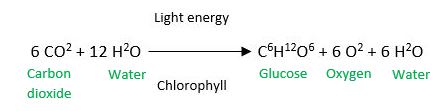
Note that water is both a reactant and a product of the reaction.
Photosynthesis is divided into two phases: the light-dependent reaction, and the carbon fixation reaction. These two processes occur in an intracellular structure called chloroplast, but we will come back to this later.
To put it simply, plants absorb sunlight thanks to chlorophyll, a pigment reflecting green light and absorbing sunlight at the optimal wavelengths to power photosynthesis. This captured sunlight energy will energize electrons by splitting water molecules, which will produce oxygen but also ATP and NADPH from precursor molecules. Now we have energy to power the next phase: carbon fixation reaction!
This step is also called the Calvin cycle. It is a complex cascade of chemical reaction, so I will summarize the important events of this cycle and not go into too many details.
First, 6 molecules of CO2 are incorporated into another molecule called RuBP, which act as a carbon skeleton, and enter the Calvin cycle. After being broken into 2 smaller molecules called PGA, they encounter ATP and NADPH.
And then, a tragedy occurs! The small PGA molecules are brutally attacked by the vicious ATP and NADPH, which steal their phosphate atoms! They manage to escape, but alas, they are now sugar molecules…
Humm, joke aside, imagining little scenarios, even ones as silly as this one to illustrate complex chemical reactions really help to memorize them. You can even replace the molecules name with well-known characters, like Pikachu for electrons.
Back to being more serious, the sugar molecules produced, called G3P, will then be used to synthesize carbohydrates such as glucose, the ATP and NADPH are recycled to be reused, the same occurs to the RuBP, and the cycle can start anew.
If you have difficulties to visualize these two phases, I refer you to Figure 1 below which summarize them and shows the main inputs and outputs of the reactions.
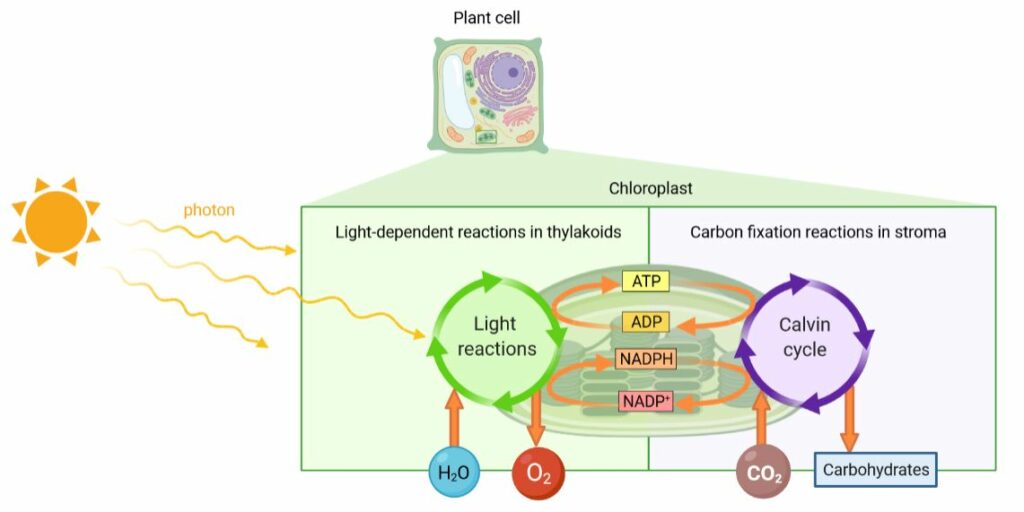
And that is it! The photosynthesis reaction is finished. Let check the equation from before: we now have six oxygen from the light dependent reaction, and one glucose plus six water from the Calvin cycle.
Now that we know roughly how photosynthesis work, we need to know where it occurs.
If you want to learn more about photosynthesis, CrashCourse made a great video about it that you can find here.
Where does it happen?
Now that we looked into the biochemistry of the process, let us look at what allows the cells to DO photosynthesis. After all, if we want to see if a human being could perform it, we need to know its origin.
Please take a look at Figure 2 below, which illustrates the differences between a plant cell and an animal cell, and in particular their organelles.
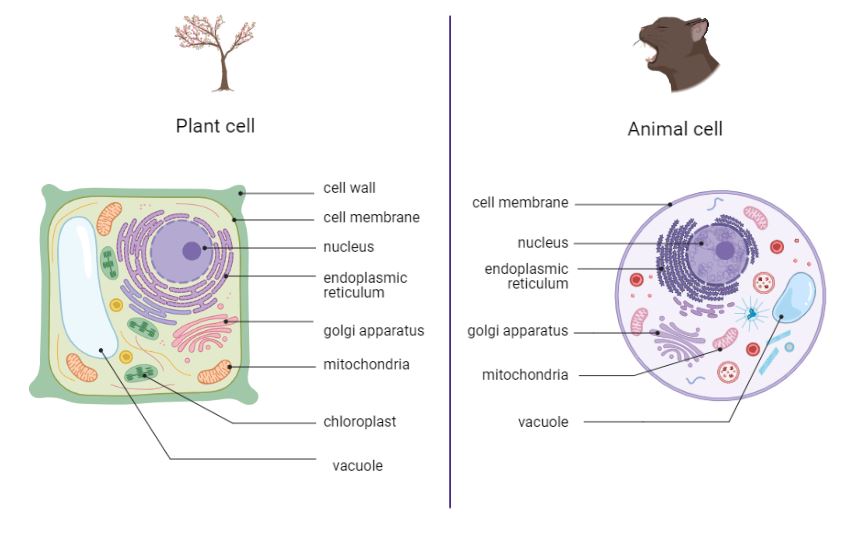
As you may have found out, there are two major differences between animal and plant cells: the cell wall, and the chloroplasts. For photosynthesis, we are only interested in this last one.
The chloroplasts of a plant cell are the siege of photosynthesis, which is their main but not only function. Somewhat similarly to the mitochondria, they are organelles that were integrated into the cell through an endosymbiotic event. In other words, chloroplasts were originally photosynthetic bacteria that fused with a eukaryotic cell, leading to a symbiosis between the two and creating a new type of cell.
Let's look at a chloroplast a bit closer. Please observe Figure 3.
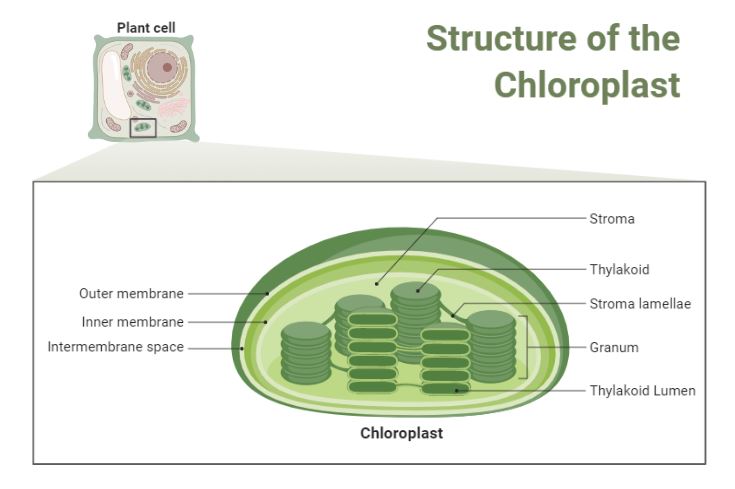
A chloroplast is surrounded by a double membrane and inside of it, an inner membrane system forms hollow flattened sacs called thylakoids. Around the thylakoids is a semi-fluid interior called the stroma. The thylakoids are stacked upon each other and form a structure named granum. Most thylakoids are connected to each other to form a closed system called the thylakoid space.
Chlorophyll is located in the thylakoids' membrane, making them the site of the light reaction, and giving the plant leaves their green color. They absorb solar energy and use electrons released by the breaking down of water molecules to produce chemical energy in the form of ATP and NADPH. These molecules are then released into the stroma, where the Calvin cycle takes place.
The small chloroplasts are therefore the reason plants have photosynthesis and likely why complex life exists on Earth. Impressive for a so little thing!
By the way, red algae and cyanobacteria (the ancestors of the original chloroplasts) also perform photosynthesis. Red algae just have a red derivative of chlorophyll.
But did you know? Some animals are in fact capable of photosynthesis! The most well-known example of this is probably the sea sheep, also called Costasiella Kuroshimae (C. Kuroshimae for short). You can see one in Figure 4 below.
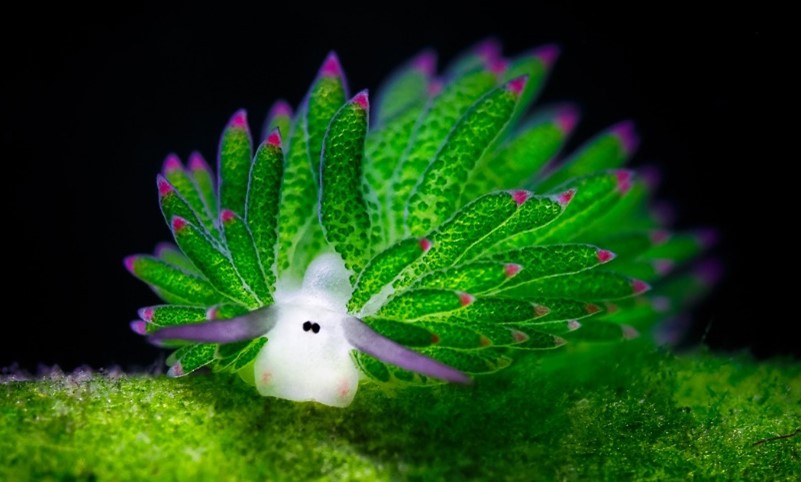
Cute isn't it? These small sea slugs were first discovered in waters near Okinawa in Japan. This animal does not live solely from photosynthesis but instead uses it as a supplementary way to get more energy when food becomes scarce, making them both autotrophic and heterotrophic.
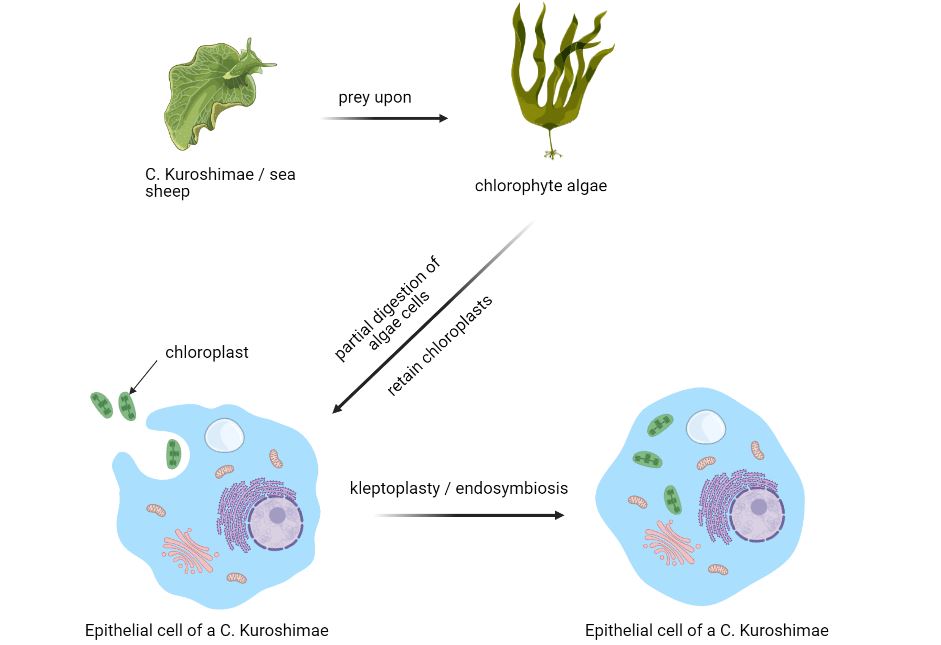
By eating algae, they retain the chloroplasts in their own cells for up to several months by a phenomenon called kleptoplasty (literally "stolen plastids"), which give them their nice, green-colored spiny projections. You can see it illustrated in Figure 5.
Not much is currently known about this endosymbiotic mechanism, but studies confirmed that the stolen chloroplasts are indeed preserved throughout their integration into the cytoplasm of the host cells and remain functional, suggesting a genetic adaptability of the slugs to support chloroplasts and photosynthesis.
If you wish to know more about these little sea sheeps, this blog has great detailed information about their biology and care.
Then, about photosynthesis in humans…
Humans, and most animals in general, do not have chloroplasts and are completely incapable of photosynthesis. For the sake of the exercise, let's imagine a way to make a human capable of it.
We will use a human model which, for ethical purposes, will be a perfect computer simulation of a human being, body and mind (unfeasible in reality, but shh...), who we will call Helios. What we want is to have Helios integrate chloroplasts into their own cells, see how that would be feasible and if, like the sea sheep, they could then indirectly perform photosynthesis. As the mechanisms of kleptoplasty are still not well understood, we will not go into detail about the exact process but instead, propose hypotheses on how we could attain it.
Chloroplasts, as previously unicellular organisms, contain their own separate genome. These DNA sequences are crucial for the maintenance of the organelle and for its function and interactions with the host cell. Similarly, nuclear DNA also contains genes whose functions are to help maintain chloroplast integrity, giving rise to coordination between the two genomes in the form of intracellular signaling.
Thanks to the sea sheeps and their cousins, we know that chloroplasts can be integrated into animal cells. But how is it done? Different hypotheses were considered to justify this capacity of Sacoglossan sea slugs to retain chloroplasts:
Step 1: Identify the appropriate chloroplast-nurturing genes (let's call them CN genes for short).
To do that, we may want to compare the expression of the genes of photosynthetic animals having integrated chloroplasts and the ones without chloroplasts. The use of transcriptomic technology seems like a good choice for this. If we find upregulated genes solely in the slugs with chloroplasts, we could begin to say that those genes may be CN genes. Further studies would be necessary to narrow down our conclusions, but in the end, we would have our genes. Now to insert them!
Step 2: Insert the CN genes into Helio's cells.
As we may need to insert multiple genes into all of Helio's cells, gene therapy would be too inefficient. Luckily, Helios is a computer simulation, so we can reverse their time back to a single cell state. Now that they are back to an embryonic stage, we may begin gene insertion. The CRISPR/Cas9 technology, which is a molecular scissor that can cut and insert our genes wherever we want into Helios's genome, would be perfect. After checking that the genes were inserted correctly, let's speed up time and grow Helios back into adulthood. Now all of their cells have CN genes.
Unfortunately, little to nothing is known about this process, but let's theorize anyway. Our CN genes may benefit from including a factor that removes any possible immune response related to chloroplasts and an ability to exchange chloroplasts from cell to cell. We would need a gradient gene expression to guide our chloroplasts from the stomach cells to the closest skin cells. This step may seem more than a bit far-fetched and some of these mechanisms may not be possible in practice, but we'll never know before we try!
Step 5: Go sunbathe and start photosynthesis. Do not forget to regularly go to a shaded area to rest your chloroplasts, Helios.
Bonus: Have green skin and algae indigestion as a result.
And voila! You have a theoretical pathway to human photosynthesis, possible in theory but probably unworkable mainly because of step 4. Damn you, we were that close!
Photosynthesis is indeed possible in animals and in theory, nothing would prevent us from performing it with the right tools. But for animals of our size, the efficiency and functionality of the process and the amount of energy required would probably set huge drawbacks. The amount of algae needed would also negate the benefit of not eating, which was our reason for wanting photosynthesis. Personally, I am not sure it would be worth the effort, but it is still fun to think about. For now, let's continue to eat delicious food!
Conclusion
Photosynthesis is a big topic, and I only scratched the surface. If some of you are knowledgeable in the domain, you must have thrown your computed through the window when seeing some of the shortcuts I took. Nevertheless, if you wish to correct me on something, yell at me, or just want to add details to things I said, you are more than welcome to do so in the comments.
A lot remains to be explained, and we can expect interesting conclusions in the future on the mechanisms of kleptoplasty and novel functions of symbiosis. The use of comparative proteomic, transcriptomic, and genomic technologies on animals with chloroplasts vs. animals without may yield promising results in the future.
I hope that I was able to interest some of you on photosynthesis and that now when you'll look at a plant, you'll remember how amazing it is!
The book "Biology, International Edition (9th edition) by Solomon; Berg; and Martin. Edited by Brooks/Cole" was a great source of information when writing this article. You can find it on Amazon here.
Last but not least, this article (and blog) would not have been possible without my beta reader, aka one of my best friends, who will recognize himself. Thank you again!